
The system behind the strategy.
VRT stands for Visibility, Relevance, Trust. It is how we score where a Challenger Brand stands in its market, and what to do about it.

Without a score, every dollar is a guess.
Most agencies start with tactics. The question is “what should we run?” and the answer is always more activity.
We start with a different question: where do you actually stand? Not against industry averages. Against the specific brands your buyers are choosing instead of you, scored on a standardized scale, honestly.
VRT is the diagnostic that puts the strategy on solid ground. Without it, every dollar is a guess. With it, every dollar has a specific gap it is closing.
The brand buyers choose showed up and held up everywhere they looked.
Modern buyers do not move in a straight line. They search, ask around, read reviews, come back to your site, compare alternatives, and search again. Three questions decide whether your brand is the one they choose.
Visibility
Will they find you?
AI and search visibility on the keywords your buyers actually use. Paid share of voice. Social reach. Local search. The platforms and resources your buyers use and trust.
Relevance
Will they perceive the fit?
Clarity of your value proposition. Messaging in your buyer's language. Storytelling, design quality, and the differentiation that gets you into the consideration set.
Trust
Will they trust your promise?
Reviews, ratings, and third-party validation. Brand consistency across every touchpoint. The signals that make the final call before a buyer commits.
How scoring works
Each brand gets a 0 to 100 score per pillar, weighted from more than 250 underlying data points. The three scores combine into one composite VRT score. Some inputs are objective: search share, review counts, social reach. Some are graded on a standardized rubric so comparisons across brands are consistent.
Scores matter most in relative terms. A 65 against a competitor at 55 signals strong footing. The same 65 against an 80 surfaces a gap worth closing.
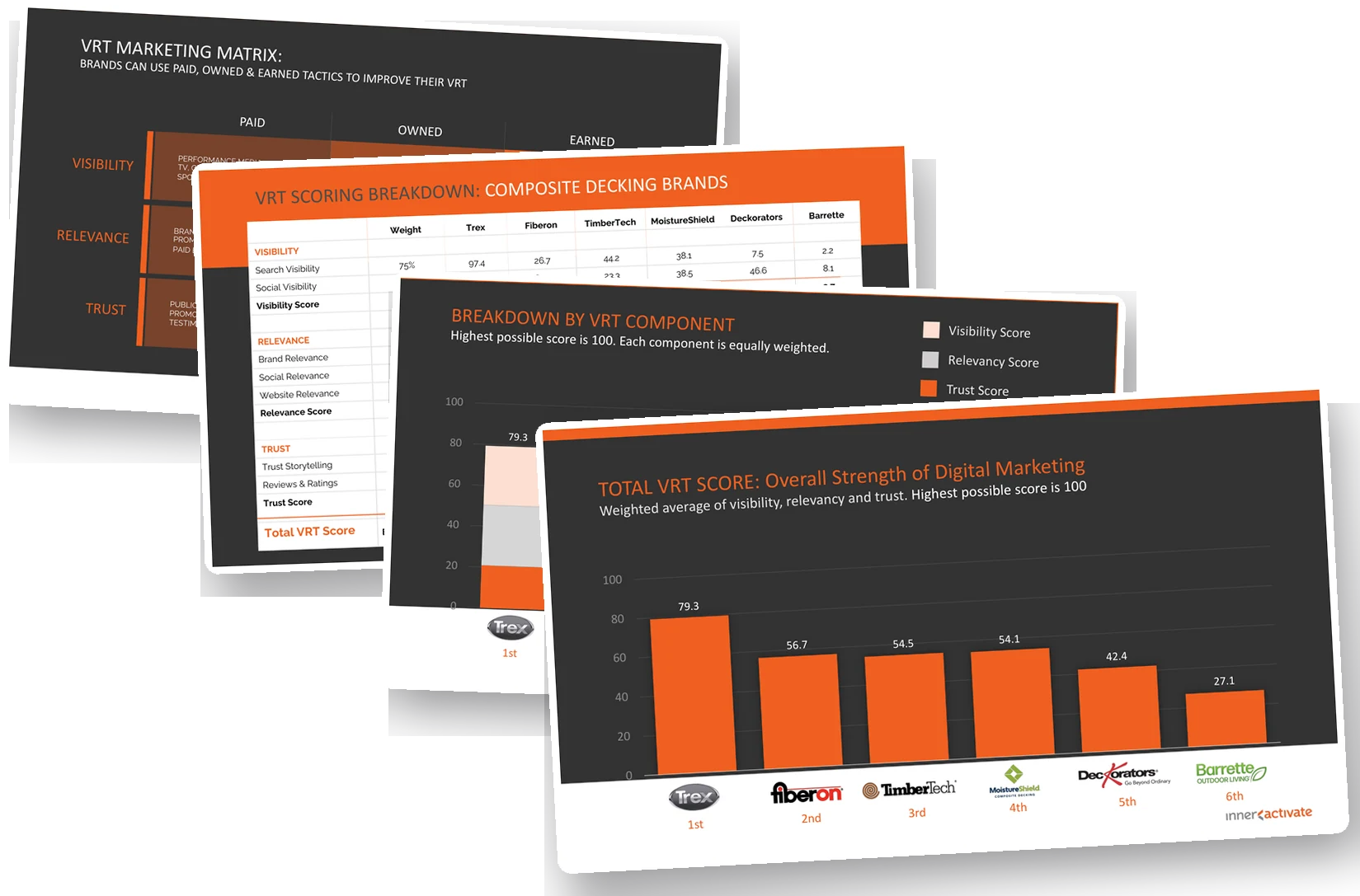
Download the example analysis
The complete composite decking VRT analysis: six brands scored across Visibility, Relevance, and Trust, with the gap analysis and the recommendations. Add your company email and it's yours.
The Marketing Matrix
Once the scorecard is complete, we cross the three pillars with three channel types (paid, owned, earned) to produce a 9-cell matrix. Each cell holds the specific tactics that close the gap on that pillar through that channel. The bridge from “here is where you stand” to “here is what to run this quarter.”
| Paid | Owned | Earned | |
|---|---|---|---|
| VVisibility | Performance media, sponsorships | SEO, content marketing, social pages | Social audiences, influencers |
| RRelevance | Brand campaigns, value-prop ads | Positioning, storytelling, UX | Brand advocates, earned audiences |
| TTrust | PR, promoted reviews, testimonials | Product and service quality | Reviews, independent testing, awards |
What a VRT Discovery delivers
Three deliverables. All yours to keep regardless of what comes next.
Your competitive scorecard
Your VRT score against three named competitors across all three pillars. Plain language. A number you can stand behind.
Your gap analysis
Which pillar is costing you the most growth and why. The Marketing Matrix populated with the tactics that close your specific gaps.
Your 90-day action plan
A prioritized playbook keyed to the highest-impact gaps the scorecard surfaced. Not the gaps we want to sell. The ones costing you buyers right now.